UUID v4 in practice: randomness, collisions and database checks
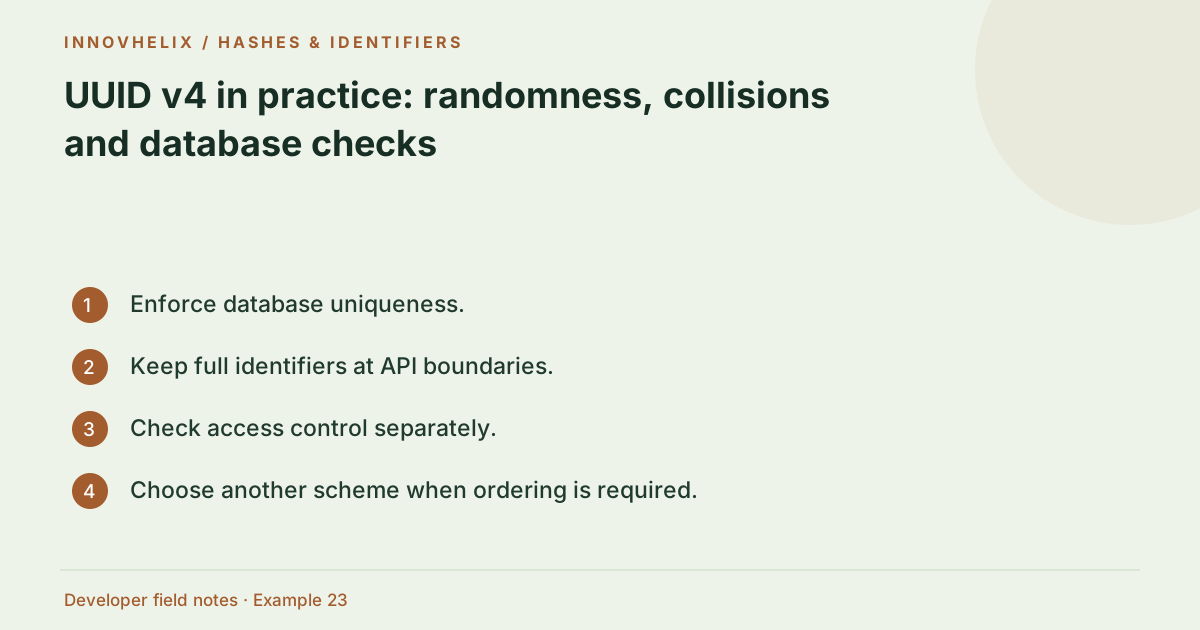
UUID v4 lets independent writers generate identifiers without coordinating a central counter. It contains version and variant bits alongside 122 random bits. It is practical for fixtures and distributed creation, but it does not replace a uniqueness constraint, provide chronological ordering or grant access to a record.
Try the UUID v4 Generator with the synthetic example below. Processing stays in your browser; the guide explains what the result can and cannot establish.
Worked example: version and variant
Use this exact sample to isolate the behavior discussed above. Keep the operation and options with the sample when reporting a result; changing the input representation can change what the test demonstrates.
Input or question
Shape: xxxxxxxx-xxxx-4xxx-yxxx-xxxxxxxxxxxxExpected result or interpretation
For the RFC variant, y is one of 8, 9, a or b.A shortened display is not a shortened identifier
A UI may show the first eight hex characters of a UUID to keep a table compact. That is a display abbreviation, not a replacement key. Different full identifiers can share that prefix, and the reduced space changes collision behavior substantially. Keep the full UUID in the record, API and Copy action, and make the abbreviated presentation clear. A lookup based only on the short prefix needs its own ambiguity policy. Test two synthetic records with deliberately identical prefixes rather than hoping a random batch produces that case. The test should verify that selecting or copying either record retains its full identity and cannot resolve silently to the other.
Recognize the format
The common textual shape is 8-4-4-4-12 hexadecimal digits. The version nibble is 4 and the variant nibble is 8, 9, a or b. These fields identify the format, not an existing application record. The tool sets these bits after requesting random bytes with crypto.getRandomValues. It reports an error if secure browser randomness is unavailable rather than using Math.random as an equivalent fallback.
Enforce uniqueness at storage
A large random space makes accidental collisions very unlikely at ordinary scales, but not literally impossible. Collision probability grows with the generated population through the birthday effect. A database uniqueness constraint also catches imported duplicates and implementation defects. Define conflict handling even if it is rarely exercised. Test insertion behavior with an intentionally duplicated UUID rather than relying only on random batches.
Separate identity from time and permissions
Version 4 includes no creation timestamp. Sorting its text does not establish creation order. Possession of a UUID also does not establish permission to view or change its record. Access control must be checked independently. A public URL can contain a random identifier and still need authorization. Choose a documented time-oriented format if ordering is a requirement rather than inferring it from v4.
Keep the full identifier consistent
Use the database’s supported UUID representation where appropriate. Document whether APIs accept uppercase hex, braces or only one normalized spelling. Short prefixes may help a compact display, but should not replace full storage or unique lookup values. Our generator produces lowercase strings and limits batches to 100 for small development tasks. Copy or download the complete result to avoid manual transcription errors.
Test identifier handling rather than random luck
A batch of unique-looking UUIDs is a useful smoke test, but it cannot prove future collision freedom. Check the visible version and variant fields and validate the complete format. Then test how your application stores, copies and looks up a known synthetic UUID. Include an intentionally duplicated value to exercise the database constraint and conflict path. That is a deterministic test of the enforcement layer.
For UI review, check long identifiers on narrow screens. A display can truncate visually while a Copy action retains the complete value, but make that distinction clear. Do not shorten the stored ID just to fit the design. For case handling, use a documented normalized representation or the database’s supported UUID type. Avoid requiring users to retype a long identifier when a reliable copy action is available. If a fixture is snapshot-based, use a fixed synthetic UUID instead of generating a new one on every run; randomness can create unrelated diffs that hide actual changes. Conversely, independent record creation tests may need generated IDs to avoid accidental test interference. The useful choice depends on the assertion. Randomness is a generation property, while repeatability, storage uniqueness and permissions remain separate application concerns.
Verification cases
- Generated UUID shape: Version is 4; variant nibble is 8, 9, a or b.
- Deliberately repeated UUID: Database uniqueness must reject or handle the conflict.
- Same fixture across snapshots: Use a stable synthetic value.
Decision reference
| Case | Meaning or choice | What to do with it |
|---|---|---|
| Randomness | 122 random bits | Secure generation |
| Uniqueness | Very low collision probability | Still constrain storage |
| Ordering | No time field | Not chronological |
| Authorization | Independent rule | An ID is not permission |
Before you use the result
- Enforce database uniqueness.
- Keep full identifiers at API boundaries.
- Check access control separately.
- Choose another scheme when ordering is required.
Continue the workflow
UUID v4 vs timestamp-based IDs: a requirement checklist addresses choose an identifier strategy. What regex validation can—and cannot—prove addresses choose validation layers appropriately.
Technical reference
Consult RFC 9562 UUID specification for the relevant underlying behavior or concept. Test the exact runtime used by your application when engine compatibility matters.
Corrections are welcome through Contact & feedback. Read our editorial policy for scope and limitations.