Hash vs HMAC vs signature: which question are you answering?
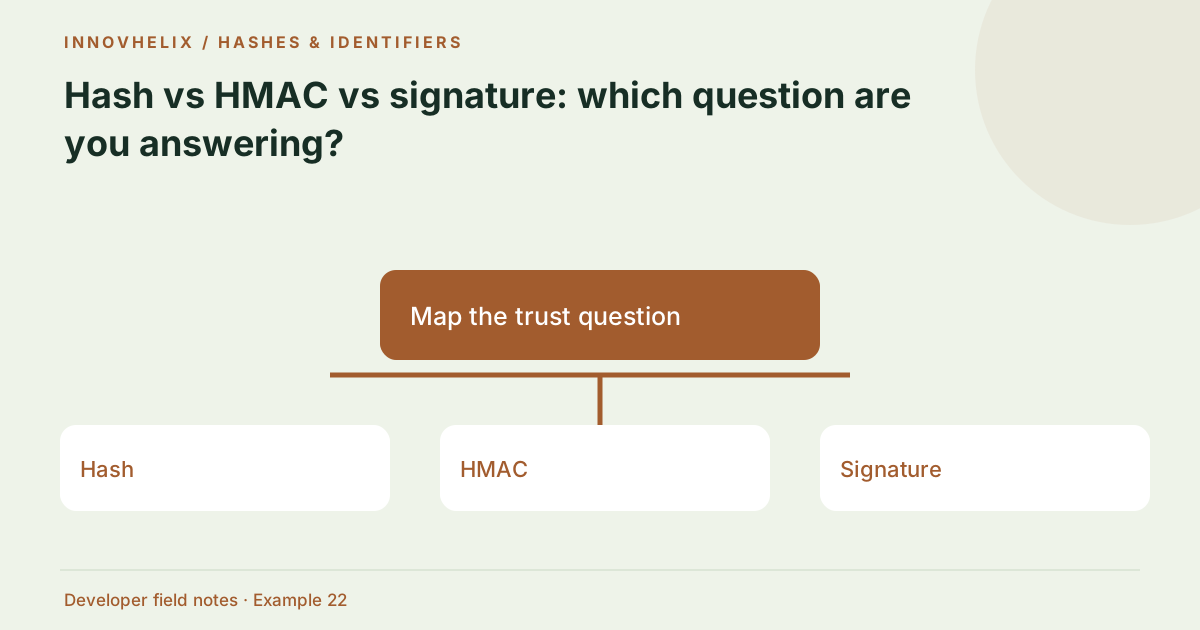
A plain hash has no secret. HMAC uses a shared secret, while a digital signature separates a private signing key from public verification. These answer different trust questions. Choose according to who may produce a valid result and what the verifier already trusts, rather than choosing the output that looks most complex.
Try the SHA Hash Generator with the synthetic example below. Processing stays in your browser; the guide explains what the result can and cannot establish.
Decision reference
| Case | Meaning or choice | What to do with it |
|---|---|---|
| Hash | No key | Trusted-reference comparison |
| HMAC | Shared secret | Shared-key authentication |
| Signature | Key pair | Trusted-public-key verification |
| Base64 | No authentication | Representation only |
A digest does not identify a sender
Anyone can calculate a plain hash of a message. If message and digest are both replaceable, an attacker can change both. A trusted reference makes an integrity comparison useful, but the primitive itself does not authenticate authorship. InnovHelix implements only unkeyed text digests. Its output should not be labeled a token signature, MAC or proof of permission.
HMAC requires shared-key management
HMAC combines a hash construction with a secret key. A verifier holding that key can check the message authentication code, and it can also produce valid codes. Key distribution, storage and rotation become part of the workflow. This site deliberately does not request secret keys or implement HMAC generation. Use the protocol’s supported library and test vectors in your authoritative application.
Signatures require trusted key identity
A signature is produced with a private key and verified under the corresponding public key using a specified scheme. The verifier must know which public key belongs to the expected signer. Verification also depends on the exact signed representation. A field named signature in JSON is merely data until these checks succeed. Public-key lookup and trust establishment are separate requirements.
Follow protocol serialization and replay rules
Reformatting raw signed JSON changes its bytes. Ad hoc sorting does not establish compliance with a canonicalization standard. Preserve the original signed content and follow the actual protocol. Authentication also requires algorithm constraints, replay handling, expiration and failure behavior. A hash can help diagnose byte differences, but it is not a substitute for those rules. Keep all production keys out of debugging samples.
Worked example: map the trust question
Use this exact sample to isolate the behavior discussed above. Keep the operation and options with the sample when reporting a result; changing the input representation can change what the test demonstrates.
Input or question
Compare a fixture to a trusted reference: hash
Authenticate with shared secret: protocol-defined MAC
Expected result or interpretation
Verify under a trusted public key: protocol-defined signatureA matching hash from the same untrusted message is weak evidence
Imagine a message includes content and a sha256 field calculated from that content. Recalculating the hash can confirm that those two fields agree, but a party able to replace the message can also replace both fields. The agreement does not identify the sender. A trusted external reference, protocol-defined MAC or verified signature changes the trust model. Which one fits depends on who may create valid messages and how keys or references are authenticated. Keep that distinction in test assertions: internal consistency and sender authenticity should not share one boolean named verified. The browser generator is suitable for inspecting consistency of controlled text, not for approving untrusted message authorship.
Document the verifier’s trust assumptions
A verification note should identify the expected sender, trusted reference or key source, algorithm and exact input representation. For a plain checksum, the trusted element is usually where the expected digest came from. For a MAC, it includes the shared key and who can access it. For a signature, it includes the public key’s identity and the scheme. These assumptions cannot be recovered by looking at the output string alone.
Use the protocol’s own fixtures when testing authentication code. A positive test should verify a documented message, while negative tests should change content, key selection or relevant parameters and fail safely. Do not accept a result merely because some library returned decoded claims. Decoding, cryptographic verification and application acceptance are separate stages. An expired or unauthorized message may be cryptographically valid but still inappropriate to accept. Preserve the raw representation until verification completes and avoid reformatting signed JSON for that step. Our hash tool can isolate whether two controlled text inputs produce the same digest, but it intentionally does not offer a secret-key field. That scope reduces accidental exposure and keeps the interface’s claim aligned with the operation it actually performs. Select a maintained protocol implementation for the rest of the workflow.
Verification cases
- Message plus replaceable plain hash: Does not authenticate the sender.
- Shared key available to both parties: Either can produce a valid MAC.
- Verified signature on expired message: Application acceptance still needs expiry checks.
Before you use the result
- State who can produce valid results.
- Preserve the signed byte representation.
- Follow the protocol’s serialization rules.
- Never share production keys in examples.
Continue the workflow
Create and compare SHA-256 checksums for text fixtures addresses verify exact text integrity with sha-256. Format JSON without accidentally changing your data addresses safely pretty-print an api payload.
Technical reference
Consult MDN browser API reference for the relevant underlying behavior or concept. Test the exact runtime used by your application when engine compatibility matters.
Corrections are welcome through Contact & feedback. Read our editorial policy for scope and limitations.