Unicode regex matches and JavaScript UTF-16 indices
The word “character” can mean a byte, UTF-16 code unit, Unicode code point or visible grapheme. JavaScript regex indices use UTF-16 code units even when a Unicode-aware pattern is enabled. That distinction matters when a match occurs after emoji, when you highlight text or when offsets are exchanged with a backend written in another language.
Try the Regex Tester with the synthetic example below. Processing stays in your browser; the guide explains what the result can and cannot establish.
Decision reference
| Case | Meaning or choice | What to do with it |
|---|---|---|
| Byte | Encoded storage unit | Depends on UTF-8 or another encoding |
| UTF-16 unit | JavaScript string offset | Used by regex match.index |
| Code point | Unicode scalar-oriented counting | Not always a visible character |
| Grapheme | User-perceived text unit | May contain several code points |
Separate the counting models
ASCII characters use one UTF-16 code unit and one UTF-8 byte, so simple examples hide the problem. An emoji outside the basic multilingual plane uses a surrogate pair in UTF-16 and usually four UTF-8 bytes. A visible accented character may be composed from multiple code points. Never label a regex index as a byte offset unless you have converted the preceding text to the same byte encoding.
Use Unicode mode deliberately
The u flag changes how several pattern constructs treat surrogate pairs and enables Unicode property escapes in supporting engines. It does not change match.index to a code-point count. A dot under u can consume a complete supplementary code point where a non-Unicode dot may consume one code unit. Keep the flags in your fixture so another developer can reproduce the observed match.
Understand the displayed index
For the subject "👋IH-1042", the code begins at UTF-16 index 2. That is a valid index for JavaScript slice, even though a person may see only one symbol before the code. If a Python service expects a code-point offset or a Rust service expects a byte position, translate explicitly. Sending the number 2 without an indexing contract is ambiguous.
Do not assume one code point is one glyph
Family emoji, flags, skin-tone modifiers and combining marks can contain several code points per visible symbol. Code-point-aware matching therefore does not solve all user-facing selection problems. Intl.Segmenter can help with grapheme segmentation in supporting runtimes. Use it when the product requirement concerns visible characters, and test fallback behavior rather than presenting code-unit counts as universally human-readable.
Normalize only under a documented policy
Visually similar Unicode text can have different underlying sequences. NFC normalization may make certain canonical equivalents easier to compare, but it changes the input representation. Do not normalize signed payloads or exact-byte artifacts without agreement. For human-entered search fields, choose and document a normalization policy, then use fixtures with both precomposed and combining sequences to verify the intended behavior.
Translate offsets only at an explicit boundary
If a browser sends an index to another runtime, include the indexing unit in the contract. To obtain a UTF-8 byte offset for a JavaScript match, encode the substring preceding match.index and count its bytes. To highlight in the same JavaScript string, use the UTF-16 offset directly. Do not convert twice or apply an offset from normalized text to an unnormalized original. The index is meaningful only for the exact subject representation used to calculate it.
Build a fixture with an ASCII prefix, an emoji prefix and a combining sequence prefix. Check start and end slicing for every match. A visible highlight should select the intended text without splitting a surrogate pair. For caret movement and truncation, consider grapheme segmentation rather than regex offsets alone. A family emoji can be one visible item assembled from several code points, so a code-point count still may not match user expectations. Keep byte counts, string lengths and grapheme counts labeled separately in diagnostic output. This prevents an otherwise correct number from being used in the wrong domain. If you normalize for search, keep a mapping strategy or avoid claiming offsets back into the original text unless you can reconstruct that relationship reliably.
Verification cases
- 👋IH-1042: Start is UTF-16 index 2, UTF-8 byte offset 4.
- ASCII prefix A: One unit in both the common ASCII counts.
- Combining accent sequence: Visible character count can differ from code-point count.
Worked example: offset after an emoji
Use this exact sample to isolate the behavior discussed above. Keep the operation and options with the sample when reporting a result; changing the input representation can change what the test demonstrates.
Input or question
Pattern: IH-\d+
Flags: gu
Text: 👋IH-1042
Expected result or interpretation
Match: IH-1042
UTF-16 start index: 2
UTF-8 byte offset: 4
Offsets change when text is normalized
Place a combining accent sequence before IH-1042 and record the JavaScript match index. Normalize the subject to NFC and repeat the search. The visible prefix may look unchanged while its UTF-16 length changes, so the two offsets need not agree. An offset calculated on the normalized string must not be applied directly to the original string for highlighting. Either display the normalized representation consistently or retain a reliable mapping between representations. The same principle applies when a backend strips whitespace before searching. Offsets belong to a specific subject, not just to the visible words it contains. Include that subject version in diagnostic reports.
Before you use the result
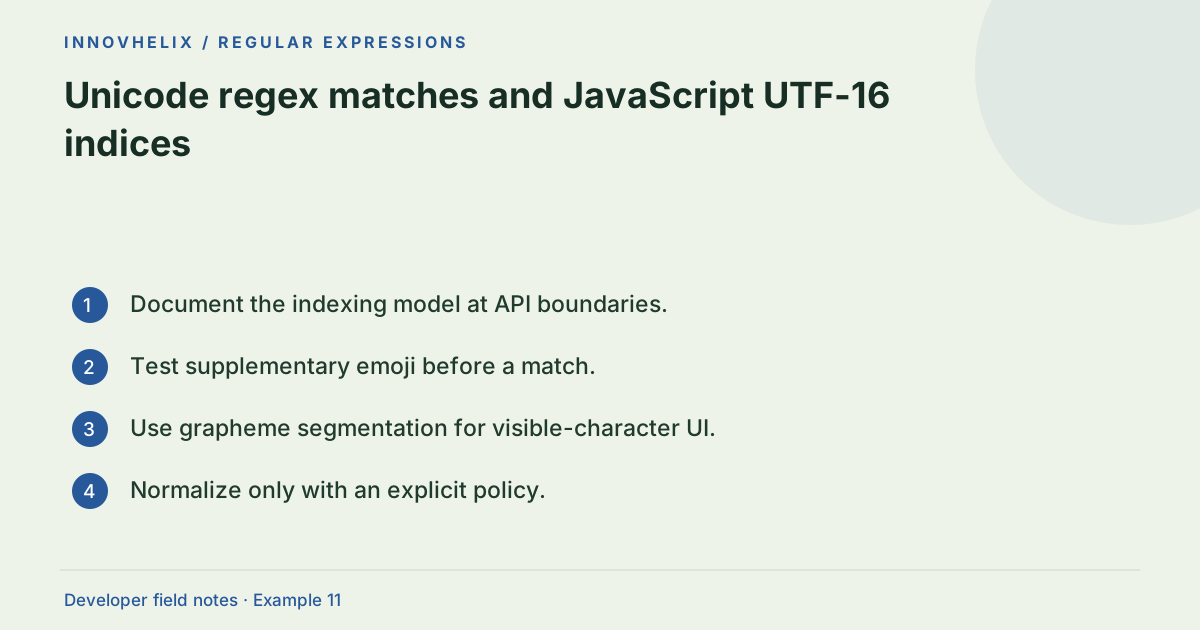
- Document the indexing model at API boundaries.
- Test supplementary emoji before a match.
- Use grapheme segmentation for visible-character UI.
- Normalize only with an explicit policy.
Continue the workflow
JavaScript regex flags explained through observable examples addresses choose regex flags deliberately. Encode Unicode text as Base64 without breaking emoji addresses fix base64 encoding of non-ascii text.
Technical reference
Consult MDN browser API reference for the relevant underlying behavior or concept. Test the exact runtime used by your application when engine compatibility matters.
Corrections are welcome through Contact & feedback. Read our editorial policy for scope and limitations.