Build synthetic test fixtures that retain the bugs you need to reproduce
Replacing real data with fake names is useful only if the replacement still reproduces the issue. Good synthetic fixtures retain the relevant types, lengths, encodings and structure while excluding secrets and personal records. A small test dataset can expose more than a large realistic dump when each row targets a defined behavior.
Try the UUID v4 Generator with the synthetic example below. Processing stays in your browser; the guide explains what the result can and cannot establish.
Before you use the result
- Retain the exact bug-triggering property.
- Give each fixture an expected result.
- Choose stable or random IDs deliberately.
- Inspect nested text and URLs for secrets.
Worked example: bug-preserving redaction
Use this exact sample to isolate the behavior discussed above. Keep the operation and options with the sample when reporting a result; changing the input representation can change what the test demonstrates.
Input or question
Original issue: quoted CSV role contains a comma
Synthetic cell: "Designer, UI"
Expected result or interpretation
Retains delimiter behavior without copying a real employee record.A replacement ID should preserve its original type
If the defect occurs when an API sends a large numeric identifier, replacing it with the string "demo" removes both the magnitude and type conditions. A safer synthetic fixture retains a long numeric token as raw JSON text for the failing case and a quoted representation for the intended contract case. Keep the digits artificial and label their purpose. This gives a reviewer a reproducer without exposing a real customer record. The same principle applies to length limits, Unicode and CSV quoting: redaction should remove identity while keeping the feature responsible for the failure. Verify that the sanitized fixture still fails before sharing it or saving it as a regression test.
Preserve the property that triggers the defect
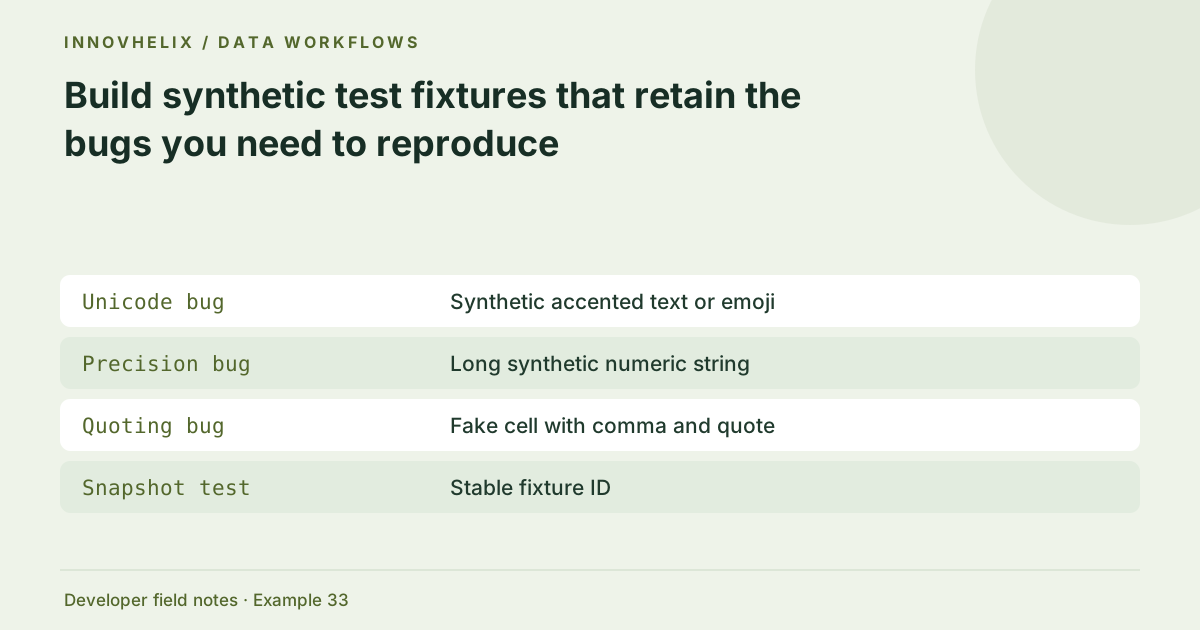
If a bug involves Unicode, replace a real name with a synthetic non-ASCII value rather than Alex. If it involves a long ID, keep the length and numeric-string representation. If CSV quoting is relevant, include a comma and quote in a fake cell. Redaction that changes the failing property can make a defect appear fixed without resolving it.
Make a boundary-oriented matrix
Include a normal value, an empty value where allowed, a maximum-length value and a malformed value. For timestamps, include explicit units and a midnight offset case. For JSON, keep null and missing properties distinct. Each fixture should have an expected result so a failure is interpretable. Avoid randomizing every property when deterministic reproduction is the goal.
Use generated identifiers selectively
UUID v4 is helpful when a test needs independent record IDs. For snapshots, a changing random ID can create noise, so use a fixed synthetic identifier instead. Never assume a generated ID grants access or exists in a real environment. Document which values are intentionally dynamic and which should remain stable between runs. Keep random data out of the assertion unless randomness itself is under test.
Review the sharing boundary
Remove authorization headers, cookies, tokens, email addresses and production endpoints from public examples. Search for embedded secrets in URLs and nested JSON strings as well as obvious fields. A useful issue report includes the small fixture, exact tool settings, expected output and observed output. Keep originals in the approved local environment when they are needed for investigation, rather than attaching a full database export.
Give every fixture a named purpose
A useful fixture name explains its role: leading-zero-id, quoted-comma-cell or offset-crosses-midnight. Record the expected result and why the edge case matters. A large dataset with plausible names can feel realistic while missing the exact condition that caused the bug. Small purposeful examples are easier to review and less likely to contain accidental production data.
Keep deterministic fixtures for assertions and use generated variation only where it adds coverage. If random input discovers a failure, save the minimized failing sample so the regression remains reproducible. Do not assume a new random UUID is appropriate in every test; snapshot output often needs stable IDs. Similarly, a synthetic timestamp should have an explicit unit and offset instead of depending on the current clock. Test data should distinguish null, empty string and missing property when those states matter. Before sharing, inspect nested strings, query parameters and headers for secrets, not just top-level fields named password. Base64 and URL encoding can conceal sensitive content visually without protecting it. A local-processing tool reduces unnecessary transfer during diagnosis, but the final report still needs deliberate redaction. The fixture should preserve the defect’s shape while removing the original record’s identity.
Verification cases
- Unicode defect: Keep synthetic non-ASCII content.
- CSV delimiter defect: Keep a quoted comma in the fake field.
- Snapshot assertion: Use stable IDs and explicit time values.
Decision reference
| Case | Meaning or choice | What to do with it |
|---|---|---|
| Unicode bug | Synthetic accented text or emoji | Keep encoding behavior |
| Precision bug | Long synthetic numeric string | Keep magnitude and type |
| Quoting bug | Fake cell with comma and quote | Keep grammar |
| Snapshot test | Stable fixture ID | Avoid random noise |
Continue the workflow
CSV quoted fields, embedded commas and multiline cells addresses parse csv quoting correctly. UUID v4 in practice: randomness, collisions and database checks addresses generate and use random uuid identifiers.
Technical reference
Consult RFC 9562 UUID specification for the relevant underlying behavior or concept. Test the exact runtime used by your application when engine compatibility matters.
Corrections are welcome through Contact & feedback. Read our editorial policy for scope and limitations.