Use a line diff to review configuration changes with less noise
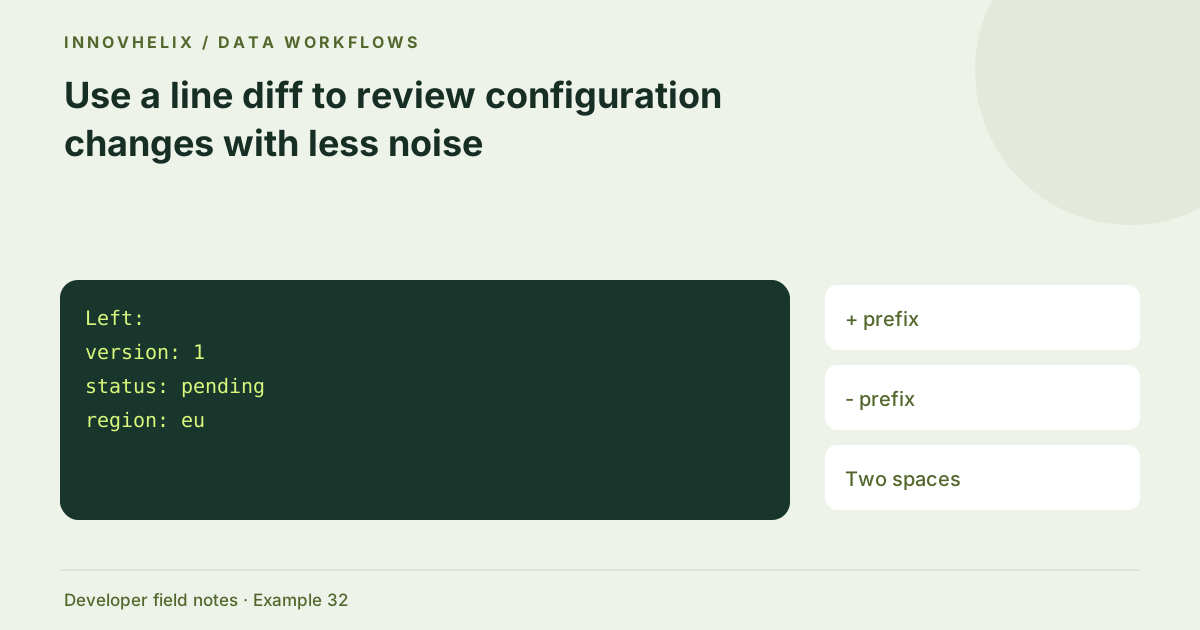
A line diff makes additions and removals visible, but it cannot understand every configuration language. Prepare comparable inputs, inspect changed blocks and then run the actual validator for the target format. This browser tool provides a bounded line comparison for small snippets, with explicit newline normalization and no claim to replace source-control review.
Try the Text Line Diff with the synthetic example below. Processing stays in your browser; the guide explains what the result can and cannot establish.
Before you use the result
- Compare matching artifact stages.
- Normalize only irrelevant differences.
- Review semantics after reading the diff.
- Run the actual configuration validator.
Worked example: small change
Use this exact sample to isolate the behavior discussed above. Keep the operation and options with the sample when reporting a result; changing the input representation can change what the test demonstrates.
Input or question
Left:
version: 1
status: pending
region: eu
Expected result or interpretation
Right:
version: 2
status: shipped
region: eu

Review version and status; region remains unchanged.
A final newline can create an extra empty line
Compare the strings "a" and "a\n" in the line diff. Splitting at LF produces one line on the left and two entries on the right, with the final entry empty. The output can therefore show an added empty line even though the visible letter is unchanged. This is useful for small text review, but it should not be confused with a byte-exact file patch. CRLF is normalized by this implementation, while the final terminator still affects the line structure. Keep a fixture for this case so users understand a blank-looking added row. If file encoding or raw line-ending bytes matter, use the original-file checksum or repository tooling instead.
Prepare equivalent representations
Compare the same artifact stage on both sides: source with source, or generated output with generated output. For JSON, matching indentation reduces cosmetic differences. Optional key sorting can help human review when object ordering is irrelevant, but array order may still be meaningful. Do not normalize a signed or exact-byte artifact merely to make the diff look cleaner.
Read the prefixes
A line beginning with plus was added in the right-hand version. Minus marks a line removed from the left-hand version. Two leading spaces indicate an unchanged line. The tool uses a longest-common-subsequence comparison, so repeated identical lines may align differently from a familiar source-control diff. It is a readable edit sequence rather than a unique explanation of developer intent.
Understand the bounded algorithm
Each side is limited to 600 lines and 500,000 characters. The algorithm stores a dynamic-programming table, so line count is capped to avoid excessive work. CRLF is normalized to LF. A final newline and remaining whitespace can still create differences. This tool does not produce a patch file, perform word-level highlighting or detect moved blocks as a distinct operation.
Turn review into validation
Check changes to endpoints, feature flags and data types carefully. Then run the target parser, schema checks or application tests. A visually small change can be behaviorally large, and a large cosmetic diff can have little semantic effect. Save the original evidence separately. Use synthetic examples when asking for help so a copied configuration does not disclose production secrets.
Build a review checklist from the changed fields
After reading the line prefixes, identify which application behaviors the changed fields control. A version change may alter a parser contract; an endpoint change may affect routing; a feature flag may activate an unfinished path. Write one targeted validation step for each meaningful change. This links the visual evidence to the actual risk rather than treating a small diff as automatically low impact.
Include repeated lines and a final newline in a tool test so you understand how the alignment behaves. Longest-common-subsequence output is one valid edit presentation, not a unique reconstruction of the author’s intent. A moved block can appear as removal and addition. The tool normalizes CRLF, so use a byte comparison or checksum if line-ending fidelity is the question. Do not call this output a patch or apply it as one; it lacks patch headers and context rules. For large code reviews, use the repository’s established tooling and tests. For small configurations, this browser view can help isolate a mismatch quickly. Keep both originals and any formatted comparison copies distinct. That way the review can use reduced noise without losing evidence about the actual artifacts that will be deployed.
When downloading the result, retain the left and right originals too. The prefixed display is a review artifact; it is not a replacement for either configuration file or a machine-applicable patch.
Verification cases
- One changed line: Expect a removal and addition around unchanged context.
- Repeated identical lines: Alignment may differ from a source-control tool.
- More than 600 lines per side: Reject the workload with a clear limit message.
Decision reference
| Case | Meaning or choice | What to do with it |
|---|---|---|
| + prefix | Added on right | Review new behavior |
| - prefix | Removed from left | Review removed behavior |
| Two spaces | Unchanged | Provides context |
| CRLF / LF | Normalized here | Not a byte-exact difference check |
Continue the workflow
Format JSON without accidentally changing your data addresses safely pretty-print an api payload. A practical JSON API debugging workflow addresses trace an api payload failure.
Technical reference
Consult NIST longest common subsequence reference for the relevant underlying behavior or concept. Test the exact runtime used by your application when engine compatibility matters.
Corrections are welcome through Contact & feedback. Read our editorial policy for scope and limitations.